Apache Kudu
Apache Kudu is an open-source storage engine for structured data that supports low-latency random access and high-throughput sequential access. It was developed by Cloudera and is now a top-level project of the Apache Software Foundation.
Kudu is designed to be highly performant, especially for use cases that require real-time data processing, such as online analytical processing (OLAP) and online transaction processing (OLTP).
It is optimized for fast read and write access to large amounts of data, and supports advanced features such as column-level encoding, compression, and predicate pushdown.
Kudu is used as the storage layer for the Apache Impala query engine and can be integrated with other big data ecosystem components like Apache Spark, Apache Hive and Apache HBase.
Architecture
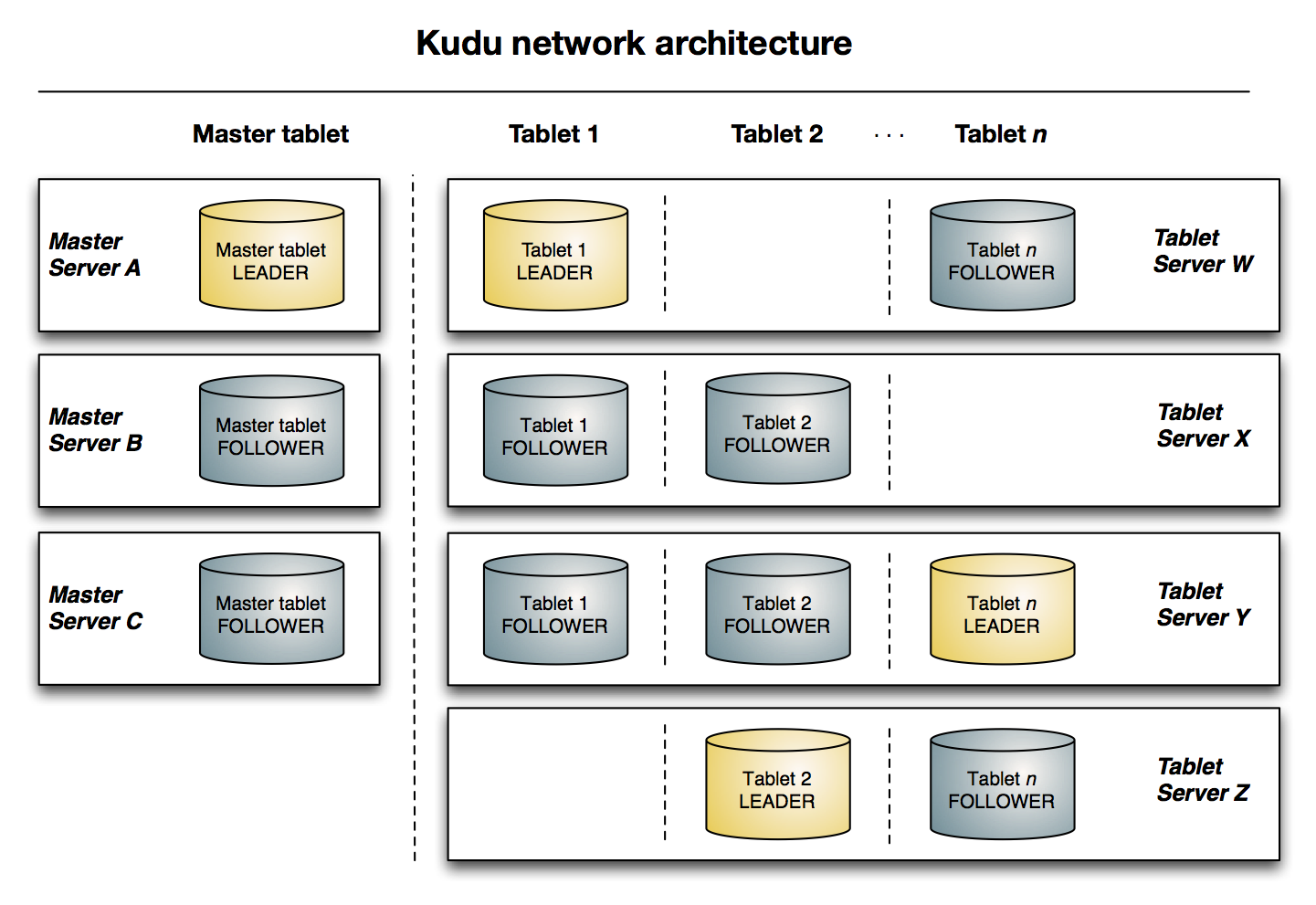
The architecture of Kudu consists of several key components:
Table: A table is where your data is stored in Kudu. A table has a schema and a totally ordered primary key. A table is split into segments called tablets.
Tablets: Kudu stores data in tablets, which are partitions of a table. Each tablet is replicated across multiple nodes in the cluster to ensure the durability and availability of data in case of node failures.
Masters: The Kudu master is responsible for managing the overall state of the cluster, including the assignment of tablets to tablet servers, monitoring the health of the cluster, and handling metadata operations such as creating and deleting tables.
Tablet servers: Tablet servers are responsible for hosting tablets, which includes serving read and write requests, and replicating tablets to other tablet servers. Tablet servers also manage the storage and retrieval of data from disk and handle communication with the master and other tablet servers. In addition, a tablet server can be a leader for some tablets, and a follower for others. Leaders are shown in gold, while followers are shown in blue.
Tablet replicas: Each tablet is replicated across multiple tablet servers for durability and high availability. Replicas communicate with each other to ensure that they are in sync.
Clients: Clients communicate with the master and tablet servers to read and write data, and perform metadata operations. Clients can be written in any language and use the Kudu API to interact with the system. Clients caches tablet metadata and figure out the leader to write to. Write failure forces metadata refresh.
Data storage: Kudu stores data on disk in a columnar format, which allows for efficient storage and query performance. Data is stored in a format called "Encoding" which allows efficient compression and encoding of data.
Write-Ahead Log(WAL): Each tablet server maintains a write-ahead log (WAL) of all write requests, which is used to ensure that data is not lost in case of a crash or other failure.
In the above example, the Kudu Master is connected to multiple Tablet Servers, each of them storing one or multiple Tablets which are the partition of a table.
When a client issues a write or reads request to Kudu, the request is first sent to the Kudu Master. The Kudu Master then forwards the request to the appropriate Tablet Server, which is responsible for the specific tablet that the request is targeted at.
The Tablet Server then performs the requested operation and returns the results to the client. If the requested data is not stored on the local Tablet Server, the Tablet Server will forward the request to the appropriate Tablet Server that holds the data.
The Kudu Master is also responsible for monitoring the health of the tablet servers and reassigning tablets in case of failures.
In summary, the Apache Kudu architecture is based on a master-tabletserver architecture, where the Kudu Master is responsible for managing the overall state of the cluster, and Tablet Servers are responsible for storing and serving the data stored in tablets. The Kudu Master handles the client requests and forwards them to the appropriate Tablet Server, which performs the requested operation and returns the results to the client.
Metadata
Catalog Table
The catalog table is the central location for the metadata of Kudu. It stores information about tables and tablets. The catalog table may not be read or written directly. Instead, it is accessible only via metadata operations exposed in the client API.
The catalog table stores two categories of metadata:
Tables: table schemas, locations, and states
Tablets: the list of existing tablets, which tablet servers have replicas of each tablet, the tablet’s current state, and start and end keys.
Apache Kudu as a separate cluster in CDP
Apache Kudu can be deployed as a separate cluster in Cloudera Data Platform (CDP) to provide a high-performance storage layer for structured data. CDP is a platform for big data management and analytics, which provides a comprehensive set of tools and services for managing, processing, and analyzing large datasets. By deploying Kudu as a separate cluster in CDP, you can take advantage of its advanced features, such as low-latency random access, high-throughput sequential access, and column-level encoding, to support real-time data processing use cases such as online analytical processing (OLAP) and online transaction processing (OLTP).
When deploying Kudu as a separate cluster in CDP, you will have the ability to configure and manage the cluster using Cloudera Manager, which provides a web-based interface for managing and monitoring the cluster. Additionally, you can use the various tools and services provided by CDP, such as Apache Impala, Apache Spark, and Apache Hive, to interact with and analyze the data stored in Kudu.
Furthermore, Kudu can be integrated with other big data ecosystem components like Apache Hbase, providing a high-performance storage layer for structured data and a low-latency, random-access data model. Additionally, it can be used as a data source for Apache Spark, allowing you to perform real-time data processing and analytics on top of your structured data stored in Kudu.
Tablet Replication
In Apache Kudu, data is stored in tablets, which are partitions of a table. Each tablet is replicated across multiple nodes in the cluster to ensure the durability and availability of data in case of node failures.
The replication of tablets in Kudu is based on the Raft consensus algorithm. Each tablet is associated with a Raft group, which consists of a leader node and one or more follower nodes. The leader node is responsible for receiving and processing write requests and replicating the changes to the follower nodes. The follower nodes are responsible for maintaining a copy of the tablet and ensuring that they are in sync with the leader.
When a client issues a write request, the request is sent to the leader of the Raft group that is responsible for the specific tablet. The leader then appends the request to its write-ahead log (WAL) and replicates the same to all the followers in the group. Once a majority of the group members have acknowledged the replication, the leader applies the change to its local copy of the tablet and responds to the client.
The replication factor of tablets can be configured depending on the use case, for example, in a high-availability setup a replication factor of 3 is usually used, meaning that each tablet is replicated across 3 nodes in the cluster.
In summary, in Apache Kudu, each tablet is replicated across multiple nodes in the cluster, using the Raft consensus algorithm, which allows for automatic failover in case of node failures, ensures that all replicas of a tablet are consistent, and enables parallel processing of write requests across the cluster. The replication factor can be configured to meet the desired availability and durability requirements.
Raft Protocol in Apache Kudu
Apache Kudu is a distributed data storage system that uses the Raft consensus algorithm to maintain consistency and durability of data across the cluster. In Kudu, Raft is used to replicate the write-ahead log (WAL) that records all data changes made to the system.
When a client issues a write request to Kudu, the request is sent to the leader of the Raft group that is responsible for the specific tablet (a partition of a table) that the request is targeted at. The leader then appends the request to its WAL and replicates the same to all the followers in the group. Once a majority of the group members have acknowledged the replication, the leader applies the change to its local copy of the tablet and responds to the client.
If the leader fails, one of the followers in the group will be elected as the new leader and take over. The new leader will then catch up on any changes that were not yet replicated while it was a follower.
Raft in Kudu provides several benefits:
It allows for automatic failover in case of leader failure, ensuring that the system remains available for writes and reads.
It ensures that all replicas of a tablet are consistent, even in the presence of network partitions or other failures.
It enables multiple leaders for different tablets, allowing for parallel processing of write requests across the cluster.
In summary, Raft is used in Apache Kudu to ensure the durability and consistency of data, by replicating and persisting writes to a WAL across the nodes of a kudu cluster, it also allows for automatic failover and parallel writes processing.
Q: What are the best practices on creation of tables in Apache Kudu?
When creating tables in Apache Kudu, there are several best practices to keep in mind to ensure optimal performance and data organization:
Choose an appropriate primary key: Kudu uses the primary key to distribute data across tablets, so it's important to choose a primary key that will evenly distribute the data. A good primary key should have a high degree of cardinality, or unique values.
Use column predicates: Kudu can take advantage of column predicates to filter data at the storage layer, so it's important to define predicates on columns that will be used in WHERE clauses.
Use column encoding: Kudu supports several types of column encoding, such as run-length encoding, dictionary encoding, and bit-packing, which can help compress and optimize data storage.
Use partitioning: Kudu supports range partitioning and hash partitioning, which can be used to evenly distribute data and improve query performance.
Use bucketing: Kudu supports bucketing, which can be used to group similar data together for improved query performance.
Design for high write throughput: Kudu is designed for high write throughput and can handle a large number of concurrent writes. When designing your tables, keep in mind the write pattern and optimize accordingly.
Monitor and tune performance: Kudu provides several metrics that can be used to monitor performance and identify potential bottlenecks. Regularly monitoring and tuning your tables can help ensure optimal performance.
Use appropriate data types: Kudu supports a variety of data types, but some are more efficient than others. For example, using INT instead of BIGINT will save a lot of storage space, and using BOOLEAN instead of INT for boolean columns
By following these best practices, you can ensure that your tables are designed for optimal performance and data organization in Apache Kudu.

